

Aviation
Polish Air Navigation Services Agency
UX in an environment with zero margin for error
Context: Where seconds determine safety
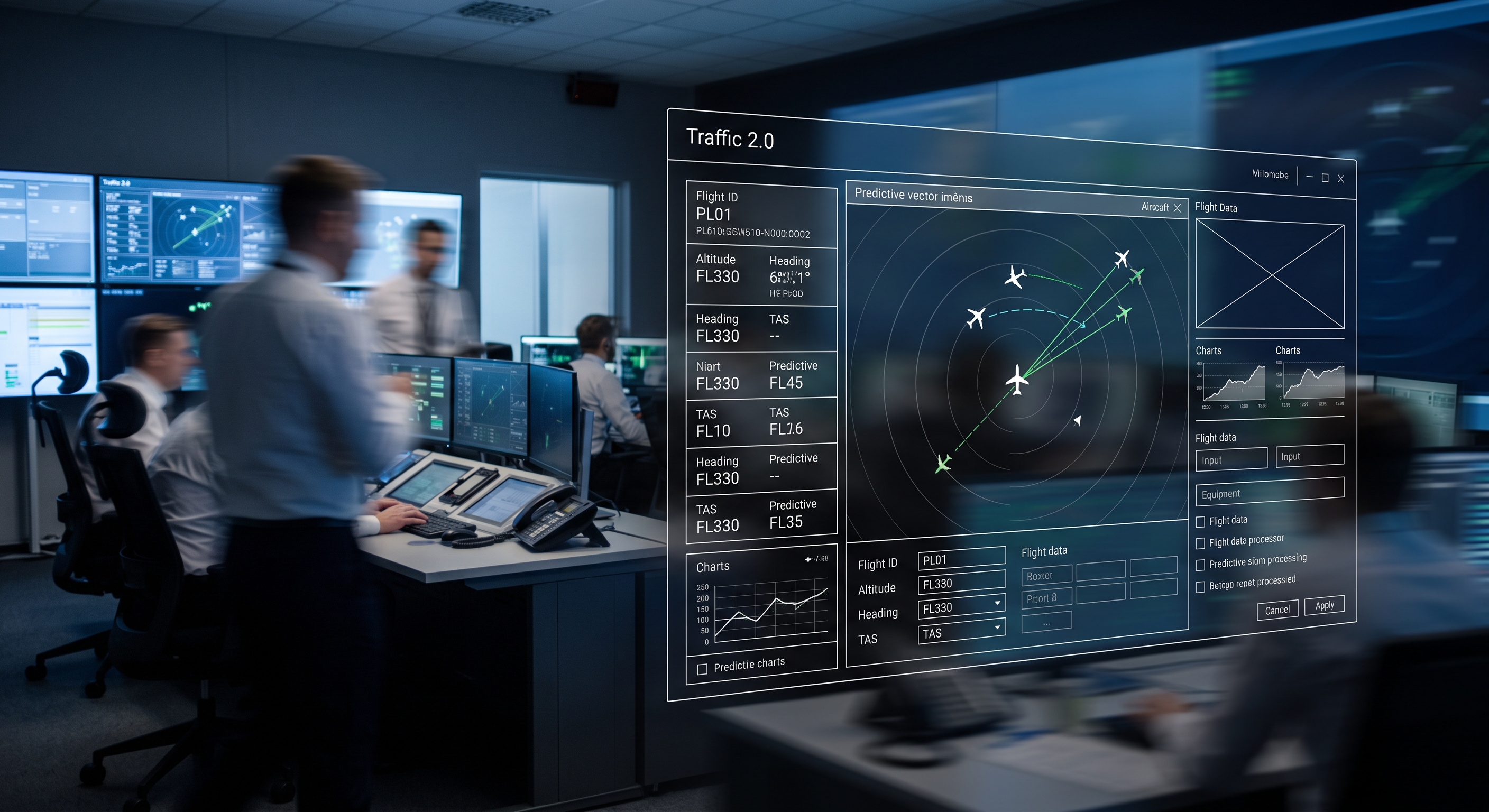
Working on systems for air traffic control is one of the most demanding challenges in the world of digital products. There is no room here for interfaces that are merely “good enough.” Drawing on my many years of experience designing for complex industries, I joined the Polish Air Navigation Services Agency to lead the Discovery phase and design process for two critical operational initiatives: Traffic 2.0 and the Traffic Complexity Tool (TCT).
The main goal? To understand operators’ cognitive load and deliver solutions that support real-time decision-making.
Project 1: Traffic 2.0
Building a new flight management system from the ground up
Flight management systems are the bloodstream of every air navigation services agency. Our task was not to patch old software, but to design a completely new version of the system that operators use every day.
To achieve this, I had to step into the shoes of the people responsible for processing aeronautical data. I used many hours of shadowing in the operations room and in-depth interviews (IDI). Applying the Jobs-to-be-Done (JTBD) framework helped me move away from thinking about “system features” and focus instead on the real tasks and pressure users face.
“In the old environment, we sometimes had to combine data from three different sources just to approve a single change in a flight plan. When you have dozens of aircraft on the monitor, I need the system to highlight anomalies immediately instead of forcing me to search for them.” — Research note (IDI), Aeronautical Data Processing Specialist
Solution and process
- Mapped the entire information flow in Miro (workflow tree), from the moment data arrives to the action taken by the operator.
- Designed a clear information hierarchy in Figma that drastically reduced the time needed to verify the correctness of a flight plan.
Project 2: Traffic Complexity Tool (TCT)
Discovery and selection of optimal software
In parallel, I led the research phase for the TCT project. This software is intended to predict traffic complexity in individual airspace sectors and help prevent overload. My task was to conduct interviews with FMP (Flow Management Position) operators to define strict UX criteria that would be used to evaluate and select the best available software on the market.
“For me, the most important thing is knowing what will happen in 45 minutes. If the system shows me only what is happening here and now, I am late with decisions about sector restrictions. The tool has to think ahead and visualize the trend, not just raw data.” — Research note (IDI), FMP Operator
The result was a comprehensive usability report and a requirements matrix from the end-user perspective. Thanks to this, the TCT software selection process was based not only on technical specifications, but also on real value for operators working with huge datasets.
Spotlight: New eFPL form
Electronic Flight Plan
One of the key tangible outcomes of my design work was creating the eFPL form view from scratch. Entering and editing electronic flight plans is a process vulnerable to errors caused by fatigue. Previous interface versions were overloaded with information.
- Cognitive grouping I divided the form into sections aligned with operators’ natural workflow: route, aircraft parameters, and estimated time.
- Real-time validation Instead of reporting errors only after submitting the form, the new interface immediately flagged logical conflicts in the flight plan.
- Accessibility I optimized contrast and typography size for work in the specific lighting conditions of an operations room.
Summary
The PANSA project proved that even in the most specialized, legally regulated industries, UX methodology and Human-Centered Design can bring measurable benefits. Basing decisions on deep research and the JTBD methodology allowed us to reduce information noise and create tools that genuinely work with the human mind under extreme stress.